
Wednesday, October 14, 2009
Small Businesses Suffer
As feared, small businesses have been hit hardest by the typhoons. Read here.

The Library of Congress on the Philippines
Anyone wanting to get started on learning a bit more about the Philippines could do a lot worse than reading through the Country Profile put together by the Research Division of the Library of Congress. Published in 2006, it's a touch dated (but not much), but it's still a great source of basic information on Philippine history and a terrific place to get acquainted with the key features of its economy, politics, and society.
If you prefer to download the PDF, just click here.
If you prefer to download the PDF, just click here.
Tuesday, October 13, 2009
Only a Quarter of the UN Philippines Fund Raised So Far
BBC reports that the UN appeal for $74m has raised only $19m so far.
The Philippines government has estimated the cost of the back-to-back typhoons to be at least $350m, with losses to agriculture and fisheries expected to total much more.
Due to disease risk, the UN may increase the size of its emergency appeal. The UN's emergency relief co-ordinator, John Holmes, says: "The crisis is by no means over. Indeed the hard work is just starting."
Monday, October 12, 2009
Bond(age) & Kidnapping
Bonds:
According to a few bankers, the Philippines government asked banks to submit proposals to manage its 3rd sale of dollar-denominated bonds this year. Treasurer Roberto Tan has stated that the government is "evaluating" a U.S. currency sale, but has yet to verify the bankers' statement. Last week, Finance Secretary Gary Teves said the government may sell at least $250 million of dollar bonds in response to this year's record budget shortfall, which has been exacerbated by the recent flooding. More info here.Kidnapped:
Father Michael Sinnott, a 79-year old Irish missionary, was kidnapped yesterday by 6 gunmen in Pagadian City, Mindanao. Father Sinnott, who has been in the Philippines since 1976, runs a school for children with hearing difficulties. No group has yet claimed responsibility for the kidnap, but there is suspicion of the Abu Sayyaf, an al-Qaida linked guerilla group.
Saturday, October 10, 2009
Typhoon Parma's Damage
Typhoon Parma has caused a series of landslides in northern Philippines, leading to more than 160 deaths. More here .
Monday, October 5, 2009
The Philippines and the UN's HDI 2009
 Is it possible to array the "human development" of different countries along a single continuum? Can you rank different countries in terms of their "human development"? Can you summarize the "human development" of a particular country using a single number? If such things seem possible to you, is doing so desirable or dangerous? Is such an enterprise meaningful or misguided?
Whatever you think, it's clear what the United Nations Development Program (UNDP) thinks. Yesterday, it released its annual Human Development Report, which contains its Human Development Index, last calculated for 2007.
I won't go into the wonky details about the calculations. Let me simply note today that the Philippines comes in at #105, right behind Algeria and just ahead of El Salvador. This puts the Philippines in the "Medium human development" category. You can find the full rankings in the summary of the report.
Other southeast Asian countries in the same category include Thailand, Vietnam, Indonesia, and Cambodia. After a quick glance at the summary, it seems that Singapore ("Very high human development") is the highest ranked country in the region, followed by Malaysia ("high human development"). Norway leads all countries, and the United States is thirteenth.
On Slums and Floods
Check out a NY Times article on Typhoon Ketsana revealing the Philippines' weaknesses in infrastructure and disaster-response preparedness. The article also covers the issue of relocating slum dwellers (which would clear waterways) and the political and culture barriers of doing so.
While shantytowns and residents' garbage disposal practices indicate issues of development and infrastructure in the Philippines, Evangeline Perdito reminds us that the the poor should not be blamed for the troubles of Metro Manila, but that the real culprits are poverty and a lack of employment opportunities. She states:
“Who would want to live under this bridge? We don’t, but where would we go? We cannot go back to the province because there’s nothing for us there.”
A Plug for: Newsbreak
Check out Newsbreak for an in-depth understanding of Philippine events through comprehensive stories, investigative reports, analysis, and insider information.
Newsbreak covers the following areas:
- Congress
- the Presidency
- Security Sector
- the Judiciary
- the Media
- Local Governments
- Elections
- Business
- the Economy
- Human Trafficking*
*their Human Trafficking section is particularly comprehensive and worth checking out!
Sunday, October 4, 2009
It's gotta be the shoes. Or not.
After her husband was ousted from power in 1986, it was discovered that Imelda Marcos had left behind a staggering 2,700 pairs of shoes in Malacanang Palace, their former official residence in Manila. Nowadays, it seems that no mention of her is complete without a snarky reference to her shoe collection.
Who was this woman who amassed so many shoes that she could wear a different pair every day for more than seven years and not wear the same pair twice? Who was Imelda Marcos in her own words? What can the story of her life tell us about the Philippines under the Marcos regime? What can our response to her story tell us about ourselves?
 Anyone interested in these questions can't miss the upcoming, campus screening of Imelda, a prize-winning documentary by Ramona Diaz.
The International Policy Student Association (IPSA) at the Ford School will be hosting the screening on October 6, 2009 at 6:30pm in Room 1230, Weill Hall.
Imelda debuted to wide, critical acclaim. In 2004, it was nominated for the grand jury prize in documentary film at the Sundance Film Festival, where its cinematographer, Ferne Pearlstein, won for best documentary cinematography.
Diaz and her crew obtained remarkable access to Marcos, spending a month shadowing her all across the archipelago and even staying with her at her 42-hectare, seaside compound in Olot. The result is a portrait of the first lady that Diaz herself likens to a litmus test of sorts:
After interviewing dozens of supporters and detractors of the former first lady, I have found that Imelda seems to be a kind of litmus test for how Filipinos think of ourselves and our relationship to the "masses"—how can we love the people if they love her? How do we resist her imagery and what she stands for and how she defines Filipino pride without distancing ourselves from everything Filipino? I am not sure that this film gives us definitive answers to these questions. My one hope is that it poses the right questions.For more on the film, check out this online feature on PBS.
Friday, October 2, 2009
Parma Projected for Landfall on Saturday
Typhoon Parma remains on course with the Philippines and is expected to hit the island on Saturday. Parma has had sustained high winds of 138 mph and some speculate that the typhoon may evolve into a super-typhoon, which means winds may ultimately exceed 150 mph. President Gloria Macapagal-Arroyo has ordered mandatory evacuations of lower lying areas in the path of Parma. Meteorologists anticipate that the storm will move slowly as it passes over the island, causing more flooding, mudslides, and major property damage. More information can be found on CNN.com.
Thursday, October 1, 2009
Parma Tracker
As the Philippines braces for another oncoming storm, you can follow the most recent weather reports here. We're all keeping our fingers crossed that the storm takes a northernly path and dissipates east of the continent.
Faces to the Flood: Ondoy's Aftermath

People are stranded in Cainta, province of Rizal, eastern Manila.

A boy is lifted onto the roof of a building to escape the flooding in the Quezon City suburban of Manila. Nearly a month's worth of rain fell in just six hours Saturday, triggering the worst flooding in the Philippine capital in 42 years, which stranded thousands on rooftops in the city and elsewhere.
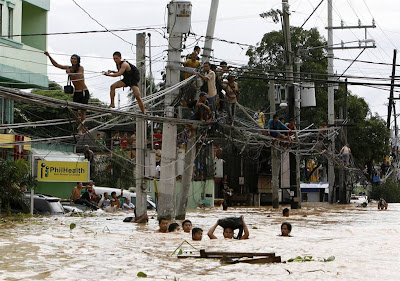
Residents clamber on electric wires to stay out of floodwaters while others wade neck-deep in Cainta Rizal, east of Manila.

A victim of floodings is rescued in Pasig City , east of Manila . Authorities rushed rescue and relief to thousands of people who spent the night on the roofs of their submerged houses in Manila and surrounding province.

Commuters wade through waist-deep floodwaters after heavy rains dumped by Tropical Storm Ketsana (locally known as Ondoy) on Saturday, Sept. 26, in Manila , Philippines.


Residents cross a flooded street with the use of a rope in Quezon City.

Thousands of people in the Philippine capital and nearby towns were marooned by flash floods after a strong tropical storm hit the main island of Luzon.
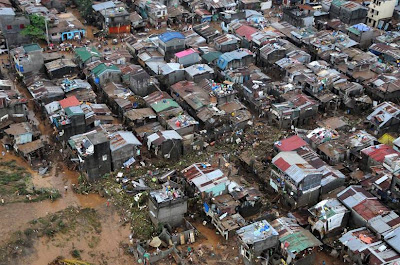
A Philippine Air Force aerial shot shows damaged houses in Marikina City , Metro Manila. More than 70 people were killed, Manila was blacked out and airline flights were suspended as a powerful tropical storm battered the main Philippines island of Luzon. Residents wait to be evacuated from a partially submerged house during flooding in Bocaue, north of Manila

Residents are evacuated by police boats during flooding in Cainta Rizal, east of Manila.

An aerial view aboard a Philippine Air Force chopper shows devastation brought by Tropical Storm Ketsana in Cainta, province of Rizal , eastern Manila.

A woman grieves in Pasig City , east of Manila
Parma isn't just a city in Italy
Unfortunately, it's also a "super-typhoon" that is menacing the Philippines.
Parma might make Ketsana look like a gentle spring shower. CNN is reporting that Parma's winds are now being measured at 150mph. Remember that Ketsana yielded the heaviest rainfall in nearly 40 years, and it has disrupted life for more than 2 million people, with more than half a million of them evacuated from their homes. At least 246 people have lost their lives.
According to the NOAA, a "typhoon" is what a "hurricane" is called in the northwest Pacific Ocean, west of the dateline. That means that Parma is a Category 4 hurricane, right on the edge of becoming a Category 5 hurricane. You may remember that Katrina was briefly a Category 5 storm before striking New Orleans as a Category 3 storm.
Subscribe to:
Posts (Atom)


 Posts


